
How are chemical disasters prevented?
Scientific information for commenting on EPA’s proposed rollback of chemical disaster protection
Burnley Truax, MPH
Chemical disasters are often preventable and pose a serious threat to workers and surrounding communities. [1] One of the federal agencies responsible for issuing protective policies related to chemical disasters — the Environmental Protection Agency (EPA) - is currently rolling back protective policies published under the Biden Administration. EPA is accepting public comments on this proposed rule through May 11, 2026.
What are chemical disasters and how common are they?
A chemical disaster is an unanticipated release of toxic chemicals that causes serious harm to public health and the environment, such as deaths, injuries, evacuations, shelter-in-place orders, environmental contamination, and facility shutdowns with permanent job loss. [1,2] Chemical disasters harm workers and communities living near chemical facilities. [1] EPA itself has stated, “there are approximately 131 million people living within three miles of RMP facilities, of which approximately 20 million identify as Black or African American, 32 million identify as Hispanic or Latino, and 44 million earn less than or equal to twice the poverty level.” [3]
In the United States, there are about 12,000 facilities that use extremely hazardous substances in large quantities. [4,5] These facilities include: chemical manufacturers, petroleum refineries, power plants, paper mills, refrigerated warehouses, storage and distribution terminals, water and wastewater utilities, and others. [4] Facilities have reported 609 chemical disasters to the U.S. Chemical Safety and Hazard Investigation Board (CSB) — an independent, non-regulatory agency that investigates chemical disasters. Among these disasters, 92 (15%) caused fatalities, 334 (55%) caused serious injuries, and 292 (48%) caused significant property damage over $1 million. [6]
One of the deadliest disasters occurred in 2013 at a West, Texas facility. A chemical explosion of ammonium nitrate caused fifteen fatalities and destroyed one-half of the town at the cost of $100 million in damages. In addition, three hundred people were injured and five hundred buildings were destroyed, including many homes and public buildings as well as two schools and a nursing home. [7] CSB published a video and report of the incident on their website. [8] After this disaster, President Obama issued an Executive Order requiring EPA to improve the Risk Management Program (RMP) regulation to prevent disasters like these from happening in the future. [7]
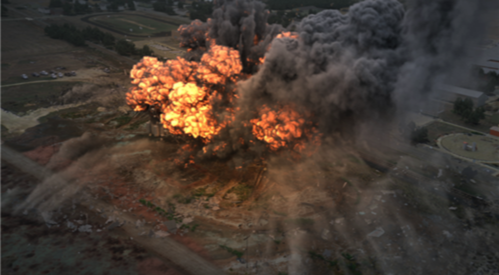
Figure 1. Explosion at a fertilizer storage and distribution facility in West, Texas. [9]
What laws are in place to prevent chemical disasters?
In 1996, EPA issued the original Risk Management Program (RMP) Rule, which requires facilities that use large quantities of hazardous chemicals to develop Risk Management Programs to plan and prevent chemical disasters. These plans include:
Hazard assessments, 5-year accident history, and worst-case/alternative scenarios;
Prevention plans covering safety precautions, maintenance, monitoring, and training;
Emergency response plans for coordinating with local authorities and training for employees training to execute them. [9]
The RMP Rule has seen a recurring cycle of strengthening and rollback across administrations:
In 2017, Obama’s EPA amended the RMP rule to require facilities to analyze whether disasters could be prevented through the use of safer technology and take other actions to prevent or mitigate harm due to chemical disasters. [1]
In 2019, Trump’s EPA rescinded the 2017 amendments. [7] This reversal was largely led by the chemical industry, which from 2012 to 2015, “spent at least $182 million opposing mandatory standards that would require facilities to transition away from the most dangerous chemicals.”[7] Based on an unsubstantiated and an incomplete investigation, the chemical industry argued that the West, Texas explosion was an act of arson and therefore unpreventable. [7] Even if it were arson, the disaster could have been prevented by not storing large amounts of ammonium nitrate in one place.
In 2024, Biden’s EPA published the Safer Communities by Chemical Accident Prevention (SCCAP) Rule. This rule reinstated some provisions that had been rolled back under the first Trump Administration and strengthened others. This rule required facilities to identify safer technology or design measures (safer technology and alternatives analysis), to increase employees’ involvement and decision-making, and greater availability of publicly accessible information, among other provisions. [3,10]
Now in 2026, Trump’s EPA is proposing to rollback protections again, repealing significant portions of the SCCAP rule. A full list of changes is on EPA’s website, which includes rescinding:
Requirements that some facilities conduct safer technology and alternatives analyses (STAA) to understand opportunities for reducing or eliminating risk.
Requirements for facilities to provide chemical hazard information to requesters.
Requirements for third-party compliance audits and root cause analysis incident investigation for facilities that have had a prior accident.
Requirements employee participation provisions, such as:
Authority of employees to stop work in order to prevent disasters and developing a process for employees to report unaddressed hazards/noncompliance. [11]
Comment on RMP’s Proposed Rollback:
Chemical disasters cause significant harm for workers and neighboring communities. Currently, EPA is accepting public comments on the proposed rollback of the Risk Management Program, a policy that prevents damage of disasters through hazard assessment and emergency planning. Read the proposed rule, fact sheet, and where to submit a public comment. The following peer-reviewed scientific information can help in responding to EPA’s proposed rule. Deadline for Public Comment: May 11th, 2026.
What do researchers say about these proposed changes?
Researchers and advocacy organizations have published their perspective on the important role the RMP Rule in protecting workers, community, and environmental health.
On safer technology rollbacks: One of the most concerning rollbacks in the proposed Trump rule involves rescinding a requirement that petroleum refineries and chemical manufacturers evaluate safer technologies and alternatives to their most hazardous processes — including processes that use hydrofluoric (HF) acid, an extremely dangerous chemical used in petroleum refining.
According to a letter to the CSB published in the Journal NEW SOLUTIONS, “More than 17 million U.S. residents live within the vulnerability zones of fifty oil refineries that operate HF alkylation units to make gasoline components.” [1] The scale of this risk can be seen in recent events at refineries in Torrance, California (2017), Superior, Wisconsin (2018), and Philadelphia, Pennsylvania (2019). There were near-misses or actual releases involving HF acid that endangered surrounding communities. In the Philadelphia incident alone, more than 5,000 pounds of HF was released, the refinery was permanently shut down, and more than 1,000 jobs were destroyed. [1]
Despite this record, the Trump EPA is proposing to roll back safer technology and alternatives analysis (STAA) requirements, rescinding requirements for petroleum refineries to evaluate whether safer alternatives to HF could be used. EPA argues these requirements place a regulatory burden on the petroleum industry. This rollback is explicitly tied to President Trump's Executive Order on "Unleashing American Energy," which directed EPA to review and eliminate requirements it deemed burdensome to domestic energy production. [12] In effect, the proposed rule prioritizes industry cost savings over the safety of the millions of people living near HF alkylation facilities.
On environmental justice: EPA's own regulatory analysis of the 2019 rollback acknowledged that weakening the rule would disproportionately and negatively impact people of color and low-income communities near industrial facilities. [1] Advocates and researchers warn that the same Environmental Justice communities will face renewed risk from the 2026 proposed rollback, which would eliminate key protections that the SCCAP rule specifically put in place for fenceline communities. [13]
On transparency and public access to information: Public transparency and engagement are widely accepted as foundational to democratic government. [1] The proposed rollback would reduce public access to information about chemical hazards in communities. Journal NEW SOLUTIONS contributor and former chief executive at CSB, Dr. Rafael Moure-Eraso, notes that the West, Texas disaster itself exposed a troubling lack of transparency: after the explosion, the Texas Attorney General began issuing opinions that allowed the state to deny open records requests about ammonium nitrate facilities. [7] Reducing, rather than expanding, public access to chemical hazard information produces a less safe and less democratic system.
On data gaps: Journal NEW SOLUTIONS contributor, Orum, identifies certain data gaps as an opportunity. [4] Currently, EPA does not track which facilities successfully reduce chemical hazards or why, leaving the agency without the knowledge needed to know alternatives that are successful.4 Orum writes, “the RMP program is missing important opportunities to share knowledge and encourage transitions that protect workers and communities." [4] To address this, Orum recommends that EPA systematically gather information from facilities that reduce their chemical hazards over time, building a knowledge base that can be shared across the industry and incorporated into future RMP planning. [4] While Trump’s EPA argues that insufficient data safer technology and alternatives make requirements unjustified, researchers see it as an opportunity to generate data.
Tell EPA not to issue this proposed rule that rescinds protections for workers and communities from the harmful impacts of chemical disasters.
Submit public comment by May 11th, 2026.
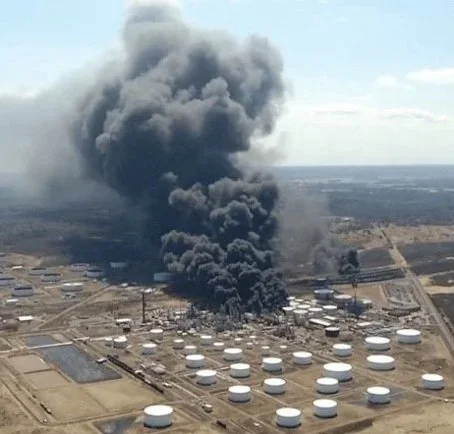
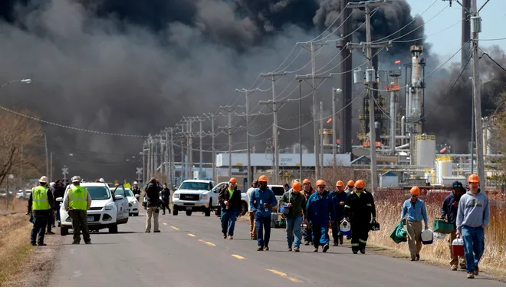
Figure 2. An oil refinery explosion in Superior, Wisconsin, resulting in 36 workers injured and $550 million in property damage. [14-16]
References:
1.  Earthjustice U. Joint Labor and Environmental Networks' Chemical Disaster Prevention Recommendations to the U.S. Chemical Safety and Hazard Investigation Board. New Solut 2022; 31: 475-483. DOI: 10.1177/10482911211064200.
2.  Organization WH. Chemical incidents, https://www.who.int/health-topics/chemical-incidents#tab=tab_1 (accessed April 22, 2026).
3.  (EPA) USEPA. Fact Sheet for Communities: Safer Communities by Chemical Accident Prevention - Risk Management Program Final Rule, https://www.epa.gov/rmp/fact-sheet-communities-safer-communities-chemical-accident-prevention-risk-management-program (2026, accessed April 30 2026).
4.  Orum P. Reducing the Potential Scope of Chemical Catastrophes in the US Chemical Industry: Evidence From the EPA's Risk Management Planning Program. New Solut 2022; 32: 155-160. 20220516. DOI: 10.1177/10482911221101046.
5.  Agency USEP. List of Regulated Substances under the Risk Management Program, https://www.epa.gov/rmp/list-regulated-substances-under-risk-management-program (2025, accessed April 22 2026).
6.  (CSB) USCSaHIB. Incident Reporting Rule Submission Information and Data, https://www.csb.gov/news/incident-report-rule-form-/ (accessed April 29 2026).
7.  Moure-Eraso R. Time to Fix the Damage of Weakened Chemical Disaster Prevention Regulations. New Solut 2022; 31: 396-399. 20210704. DOI: 10.1177/10482911211030609.
8.  (CSB) USCSB. West Fertilizer Explosion and Fire, https://www.csb.gov/west-fertilizer-explosion-and-fire-/ (2016).
9.  U.S. Environmental Protection Agency OoEM. Clean Air Act Section 112(r): Accidental Release Prevention / Risk Management Plan Rule. 2020.
10.  Environmental & Energy Law Program HLS. EPA Proposed to Revise Its Accidental Release Prevention Requirements, https://eelp.law.harvard.edu/tracker/epa-proposed-to-revise-its-accidental-release-prevention-requirements/ (2026, accessed April 30 2026).
11.  Agency USEP. Fact Sheet: Common Sense Approach to Chemical Accident Prevention – Risk Management Program Proposed Rule, https://www.epa.gov/rmp/fact-sheet-common-sense-approach-chemical-accident-prevention-risk-management-program-proposed#section7 (2026, accessed April 22 2026).
12.  Agency USEP. Accidental Release Prevention Requirements: Risk Management Programs Under the Clean Air Act; Common Sense Approach to Chemical Accident Prevention. Federal Register, , , 2026, p. 8970–9011.
13.  Minovi D. EPA, "Common Sense" is Protecting Communities and Workers from Chemical Disasters, https://blog.ucs.org/dminovi/epa-common-sense-is-protecting-communities-and-workers-from-chemical-disasters/ (2026).
14.  (CSB) USCSaHIB. FCC Unit Explosion and Asphalt Fire at Husky Superior Refinery. 2022.
15.  Sodunke O. CSB releases final report on the 2018 refinery explosion in Superior, https://www.wdio.com/front-page/local-news/csb-releases-final-report-on-the-2018-refinery-explosion-in-superior/ (2022, accessed April 22 2026).
16.  Ameel J. Several injured after an explosion at Wisconsin refinery, https://www.usatoday.com/picture-gallery/news/2018/04/26/several-injured-after-an-explosion-at-wisconsin-refinery/34283371/ (2018, accessed April 29 2026).